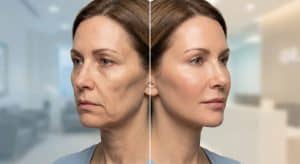
If you’re researching ways to restore facial volume—whether from aging, weight loss, or just genetics—you’ve probably landed on two main options: dermal fillers or fat transfer. Both add volume to the face. Both can make you look younger and more refreshed. But they’re very different procedures with different trade-offs.
As a plastic surgeon who specializes in facial fat grafting, I perform both treatments regularly. Here’s an honest comparison to help you decide which approach makes sense for your situation.
The Basics: How Each Treatment Works
Dermal Fillers
Fillers are injectable gels—most commonly hyaluronic acid (brands like Juvederm, Restylane, RHA) or calcium hydroxylapatite (Radiesse). A provider injects the filler directly into areas that need volume: cheeks, under-eyes, nasolabial folds, lips, jawline.
The procedure takes 15-30 minutes, requires no anesthesia beyond topical numbing cream, and you can return to normal activities immediately. Results are visible right away.
Fat Transfer (Fat Grafting)
Fat transfer is a surgical procedure. Fat is harvested from another area of your body (usually the abdomen or thighs) via liposuction, processed to purify it, then injected into the face.
The procedure takes 1-2 hours, requires local anesthesia with sedation (or general anesthesia), and involves about a week of recovery. Results take 3-6 months to fully settle as swelling resolves.
Longevity: The Biggest Difference
This is where the two options diverge dramatically.
Fillers: 6-24 Months
Hyaluronic acid fillers are gradually absorbed by your body. Depending on the product, location, and your metabolism, results last anywhere from 6 months to 2 years. Then you need another treatment to maintain the look.
Some patients need touch-ups every 6-9 months. Over a decade, that adds up to 10-20 filler sessions.
Fat Transfer: Years to Permanent
Fat transfer results are largely permanent. Not all transferred fat survives—typically 60-80% integrates successfully—but the fat that does survive becomes a living part of your face. It ages with you naturally.
Most patients need one procedure, occasionally with a touch-up session 6-12 months later if additional volume is desired. After that, results last for years.
Cost Comparison: Short-Term vs Long-Term
At first glance, fillers seem more affordable:
- Fillers: $600-$1,500 per syringe. Full-face treatment might require 4-8 syringes ($2,400-$12,000)
- Fat transfer: $4,000-$10,000 for facial fat grafting (varies by extent)
But run the numbers over time:
Fillers over 10 years: Assuming 6 syringes every 12 months at $800/syringe = $48,000
Fat transfer over 10 years: One procedure at $7,000 + possible touch-up at $3,000 = $10,000
Fat transfer costs more upfront but is dramatically more cost-effective long-term for patients who need significant volume restoration.
Ideal Candidates for Each Option
Fillers May Be Better If:
- You want to “test drive” volume before committing to surgery
- You only need small amounts of volume in specific areas
- You can’t take time off for recovery
- You prefer a non-surgical, reversible option
- You’re younger with early signs of volume loss
- Budget constraints prevent a larger upfront investment
Fat Transfer May Be Better If:
- You’ve lost significant facial volume (from aging, weight loss, or medical conditions)
- You want long-lasting results without ongoing maintenance
- You’re already considering liposuction and have donor fat available
- You’ve been getting fillers for years and want a permanent solution
- You prefer using your own tissue rather than synthetic materials
- You have “Ozempic face” or hollow cheeks from rapid weight loss
Related: Ozempic Face: How to Restore Facial Volume After Rapid Weight Loss
What About Combining Both?
Fat transfer and fillers aren’t mutually exclusive. Some patients benefit from a combined approach:
- Fat transfer for major volume restoration in the cheeks and midface
- Fillers for fine-tuning specific areas like lips or fine lines around the mouth
This gives you the longevity of fat transfer where it matters most, with the precision of fillers for smaller details.
Recovery Comparison
Fillers
- No real downtime—return to work immediately
- Mild swelling and potential bruising for 2-3 days
- Results visible immediately (though swelling may exaggerate them initially)
Fat Transfer
- Social downtime of 7-10 days due to swelling and bruising
- Swelling peaks at days 2-3, then gradually improves
- Bruising at both the face and donor site (abdomen/thighs)
- Most patients return to work at 1 week with concealer
- Final results visible at 3-6 months once all swelling resolves
If you absolutely cannot take time off, fillers are the practical choice. If you can schedule a week of downtime, fat transfer offers superior long-term value.
Risks and Complications
Filler Risks
- Bruising and swelling (common, temporary)
- Lumps or asymmetry (can often be corrected)
- Vascular occlusion (rare but serious—filler blocks a blood vessel)
- Migration over time
- Filler fatigue—some patients feel they need more and more over time
Fat Transfer Risks
- Bruising and swelling (expected, temporary)
- Asymmetry (correctable with touch-up)
- Fat reabsorption (some transferred fat doesn’t survive)
- Over-correction if too much fat is injected
- Donor site discomfort (usually mild)
Both procedures are safe when performed by experienced providers. The key is choosing someone who understands facial anatomy and has significant experience with their chosen technique.
The “Natural” Question
Patients often ask which looks more natural. The honest answer: both can look natural, and both can look overdone. The result depends far more on the provider’s technique and aesthetic judgment than on the product itself.
That said, fat does have an advantage—it’s your own tissue. It moves and ages with your face naturally. Well-integrated fat doesn’t have the slightly “firm” feel that some fillers can have.
When Fillers Stop Making Sense
I see many patients who have been getting fillers for 5, 10, even 15 years. At some point, the math stops working. If you’re spending $5,000+ per year on maintenance, fat transfer pays for itself within two years.
There’s also the issue of filler accumulation. Hyaluronic acid doesn’t always fully dissolve before the next treatment. Over years, this can create a “pillow face” appearance as filler builds up. Fat transfer avoids this problem entirely.
If you’ve been on the filler treadmill and are ready to get off, fat transfer offers a permanent exit.
What to Expect During Fat Transfer
The procedure involves three steps:
- Harvesting: Fat is gently removed from your abdomen, thighs, or flanks using specialized liposuction techniques that preserve fat cell viability.
- Processing: The fat is purified to remove oil, blood, and damaged cells. Only healthy fat cells are used for injection.
- Injection: Using small cannulas, I inject the fat in tiny droplets throughout the target areas—cheeks, temples, under-eyes, nasolabial folds, and anywhere else that needs volume.
The technique matters enormously. Fat injected in small amounts across multiple tissue layers has better survival than fat injected in large boluses. This is why choosing an experienced fat transfer surgeon is critical.
Can Fat Transfer Be Combined With a Facelift?
Yes—and this combination is becoming increasingly popular. A facelift addresses sagging skin and muscle laxity, while fat transfer restores lost volume. Together, they create comprehensive facial rejuvenation.
I frequently combine these procedures for patients who have both volume loss and skin laxity. The facelift provides structure; the fat provides fullness. The result looks natural and refreshed rather than “pulled.”
Making Your Decision
Here’s a simple framework:
- Minor volume loss + no downtime available: Start with fillers
- Significant volume loss + want long-term solution: Fat transfer
- Already getting fillers regularly + tired of maintenance: Transition to fat transfer
- Volume loss + sagging skin: Fat transfer combined with facelift
- Unsure: Try fillers first, then graduate to fat transfer if you’re happy with the volume but tired of the upkeep
Schedule a Consultation
The best way to determine which option is right for you is an in-person evaluation. During a consultation at my Beverly Hills office, I’ll assess your facial structure, discuss your goals, and recommend the approach that makes the most sense for your situation—whether that’s fillers, fat transfer, or a combination.
Ready to explore your options? Contact us to schedule a consultation.
Lost facial volume from weight loss medications? Ozempic Face: How to Restore Facial Volume After Rapid Weight Loss
Considering body contouring as well? Body Contouring After Ozempic: What to Expect