You’ve worked hard to lose the weight. The number on the scale finally reflects your effort. But when you look in the mirror, something feels off—your face looks gaunt, hollow, older than before. If this sounds familiar, you’re experiencing what’s become known as “Ozempic face.”
The good news? This is a solvable problem. As a board-certified plastic surgeon who specializes in facial fat grafting, I’ve helped many patients restore youthful facial volume after significant weight loss from GLP-1 medications like Ozempic, Wegovy, and Mounjaro.
What Is Ozempic Face?
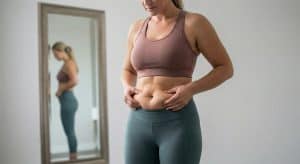
Ozempic face isn’t a medical diagnosis—it’s a term describing the facial aging that occurs after rapid weight loss. When you lose a significant amount of weight quickly, you don’t just lose fat from your midsection. You lose it everywhere, including the face.
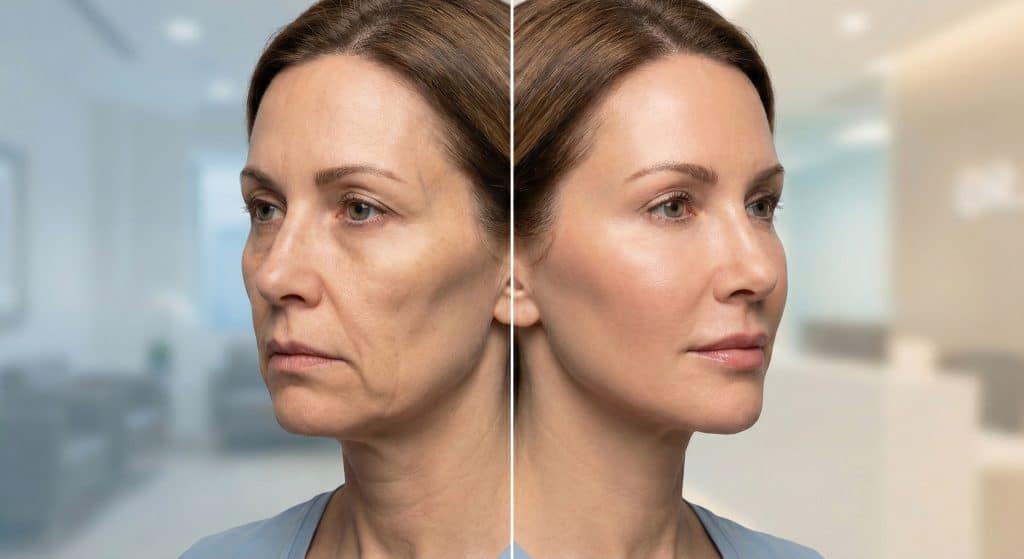
The fat pads that give your face its youthful contours—in the cheeks, temples, and under the eyes—begin to deflate. Without that underlying volume, skin that was once supported now sags. The result is a face that looks hollow, tired, and often older than your actual age.
This happens with any rapid weight loss, but GLP-1 medications have made it particularly common because:
- Weight loss is often faster than with diet and exercise alone
- The medications don’t discriminate between visceral fat and facial fat
- Many patients lose 15-20% of their body weight within a year
Signs You Have Ozempic Face
Patients typically notice one or more of these changes:
- Hollow cheeks that create shadow lines
- Sunken temples that make the skull more visible
- Deep tear troughs under the eyes
- Prominent nasolabial folds (lines from nose to mouth)
- Sagging jowls from lost midface support
- Loose neck skin that wasn’t there before
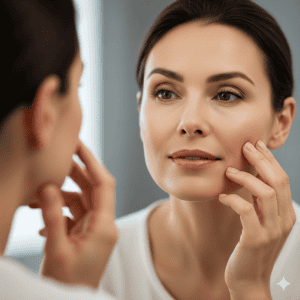
The frustrating part? You finally feel great about your body, but your face tells a different story. Many patients describe looking in the mirror and seeing someone 10 years older staring back.
Ozempic Face Treatment Options
The treatment approach depends on how much volume you’ve lost and whether you also have significant skin laxity. Here’s what actually works:
Facial Fat Transfer (Most Effective for Volume Loss)
Facial fat grafting is the gold standard treatment for Ozempic face when volume loss is the primary concern. The procedure uses your own fat—typically harvested from the abdomen or thighs via gentle liposuction—and transfers it to the areas of your face that have deflated.
Why fat transfer works better than fillers for this situation:
- Results last years, not months
- Uses your own natural tissue (no foreign substances)
- Can transfer larger volumes than fillers allow
- Fat integrates with your facial tissue permanently
- More cost-effective long-term than repeated filler treatments
During the procedure, I harvest fat using specialized techniques that keep the fat cells viable, purify it, then inject it precisely into the cheeks, temples, under-eye hollows, and nasolabial folds. Most patients need one treatment, though some opt for a touch-up session after 6 months.
Related: Fat Transfer vs. Fillers for Facial Volume: Which Lasts Longer?
Facelift for Skin Laxity
If you’ve lost a significant amount of weight (50+ pounds), you may have both volume loss AND loose, sagging skin. In this case, fat transfer alone won’t be enough. The skin needs to be repositioned and tightened.
A facelift addresses the jowling, sagging cheeks, and loose jawline that often accompany Ozempic face in patients with larger weight loss. I frequently combine facelift surgery with fat transfer—the facelift tightens and repositions the skin while the fat transfer restores the volume underneath.
This combination approach creates results that look natural rather than “pulled.” The fat provides the foundation; the lift provides the structure.
Neck Lift for Turkey Neck
Rapid weight loss often hits the neck hard. The skin under the chin and along the jawline loses its elasticity, creating what patients call “turkey neck” or a “double chin” (even without excess fat).
A neck lift removes this excess skin and tightens the underlying muscles. For patients with Ozempic face, I often perform neck lifts in conjunction with facelifts and fat transfer to address the entire lower face and neck as one aesthetic unit.
What About Fillers?
Dermal fillers like Juvederm and Restylane can help with mild Ozempic face, but they have limitations:
- Temporary: Results last 6-18 months, requiring ongoing maintenance
- Volume limits: Only practical for small areas; treating the entire face with fillers becomes expensive
- Doesn’t address skin laxity: Fillers add volume but won’t lift sagging skin
- Cumulative cost: Over 5-10 years, fillers cost significantly more than a one-time fat transfer
I recommend fillers for patients who want to “test drive” volume restoration before committing to fat transfer, or for those who only need minor touch-ups in specific areas.
The Best Candidates for Ozempic Face Treatment
You may be a good candidate for facial volume restoration if:
- You’ve lost 20+ pounds and notice facial hollowing
- Your weight has stabilized (not actively losing)
- You’re in good overall health
- You have realistic expectations about outcomes
- The facial aging bothers you enough to pursue treatment
One important note: I recommend waiting until your weight has stabilized for at least 2-3 months before pursuing treatment. If you’re still actively losing weight on GLP-1 medications, additional facial volume loss may occur. Treating a “moving target” leads to suboptimal results.
What to Expect: Recovery and Results
Fat Transfer Recovery
- Swelling peaks at days 2-3, subsides significantly by week 2
- Bruising is common but easily covered with makeup after 7-10 days
- Most patients return to work within 1 week
- Final results visible at 3-6 months once swelling fully resolves and fat stabilizes
Facelift Recovery
- More significant downtime: 2-3 weeks before returning to normal activities
- Bruising and swelling last 2-3 weeks
- Sutures removed at 1 week
- Final results continue improving for 3-6 months
Results Longevity
Fat transfer results are largely permanent—the fat that survives the transfer (typically 60-80%) becomes a living part of your face. You’ll continue to age naturally, but from a restored starting point.
Facelift results typically last 7-10 years, depending on genetics, sun exposure, and lifestyle factors.
Why Choose Dr. Neavin for Ozempic Face Treatment
Facial fat transfer is not a procedure where all surgeons produce equal results. The technique matters enormously—from how the fat is harvested, to how it’s processed, to how precisely it’s injected.
I’ve dedicated a significant portion of my practice to fat transfer procedures and lecture internationally on the topic. My approach emphasizes:
- Gentle harvesting that preserves fat cell viability
- Precise injection using micro-cannulas for smooth, natural results
- Artistic eye for facial proportions and age-appropriate volume
- Conservative approach that avoids the “overfilled” look
Many of my patients come to me specifically because they’ve seen overdone fat transfer or filler results elsewhere and want something that looks natural. The goal isn’t to look like you’ve had work done—it’s to look like a refreshed, well-rested version of yourself.
Schedule Your Consultation
If Ozempic face has you avoiding mirrors and photos, know that you don’t have to accept it as the price of weight loss. Effective treatments exist, and the right approach depends on your specific situation.
During a consultation at my Beverly Hills office, I’ll evaluate your facial volume loss, skin laxity, and overall goals. Together, we’ll create a treatment plan—whether that’s fat transfer alone, a combination with lifting procedures, or a staged approach.
Ready to restore your facial volume? Contact us to schedule a consultation.
Considering body contouring after weight loss as well? Read: Body Contouring After Ozempic: What to Expect
Experiencing loose skin on your body after weight loss? Loose Skin After Weight Loss: When Exercise Isn’t Enough