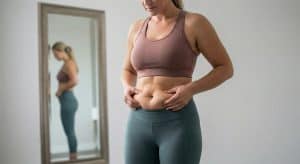
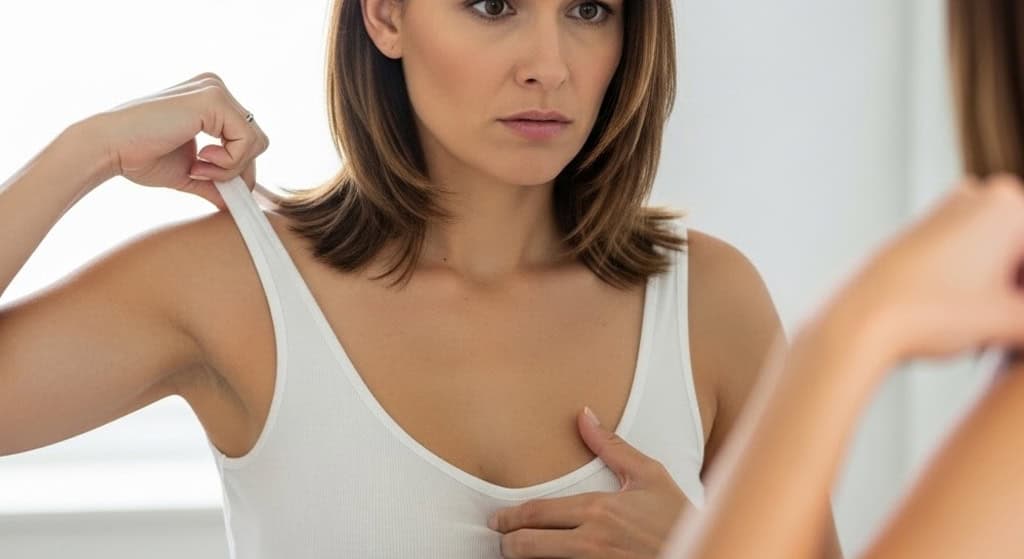
You lost the weight. You feel healthier than you have in years. But when you look in the mirror, your breasts tell a different story—deflated, droopy, and nothing like they used to be.
This is one of the most common concerns I hear from women after significant weight loss, whether from diet and exercise, bariatric surgery, or GLP-1 medications like Ozempic. The breast tissue that was once full now hangs like an empty envelope. Bras don’t fit right. Clothes don’t look the same. And many women feel like they traded one body insecurity for another.
The good news: this is fixable. The question is whether you need a lift, implants, or both.
Why Weight Loss Affects Breast Appearance
Breasts are composed of glandular tissue, fat, and skin. When you gain weight, fat accumulates in the breasts, and the skin stretches to accommodate the larger volume. When you lose weight, the fat disappears—but the stretched skin doesn’t shrink back.
The result is what patients describe as “deflated balloons” or “empty socks.” The breast tissue has decreased, but the skin envelope remains the same size. Without internal volume to support it, the breast sags.
Several factors determine how severely weight loss affects your breasts:
- Amount of weight lost: Losing 50+ pounds almost always affects breast shape
- Starting breast size: Larger breasts tend to show more significant changes
- Age: Skin elasticity decreases over time
- Genetics: Some women naturally have more resilient breast tissue
- Pregnancy and breastfeeding history: Prior stretching compounds the effect
- Speed of weight loss: Rapid loss (like with Ozempic) often creates more deflation
Understanding Your Options
Three surgical approaches can address breast deflation after weight loss:
Option 1: Breast Lift (Mastopexy)
A breast lift raises and reshapes the breast by removing excess skin and repositioning the nipple higher on the chest. It restores a perkier, more youthful breast position without changing size.
A breast lift is ideal if:
- Your main concern is sagging, not size
- You were happy with your breast size before weight loss
- You want a natural result without implants
- Your nipples point downward or sit below the breast crease
- You’re comfortable with your current cup size (or slightly smaller)
What a lift does NOT do:
- Add volume or fullness to the upper breast
- Significantly increase cup size
- Create cleavage (without implants)
A lift removes skin and tightens what’s there. If you’re hoping to restore the fullness you had before weight loss, a lift alone may leave you wanting more.
Option 2: Breast Augmentation (Implants)
Breast augmentation uses implants (saline or silicone) to add volume and create fullness. It can restore the cup size you lost or give you a size you never had.
Implants alone may work if:
- You have mild sagging but mainly want more volume
- Your nipples still sit above the breast crease
- Your skin quality is reasonably good
- You want to increase your cup size
What implants do NOT do:
- Lift sagging breasts (implants add volume but don’t raise position)
- Remove excess skin
- Reposition downward-pointing nipples
Here’s the important thing: if you have significant sagging, adding implants without a lift often makes things look worse, not better. The implant sits behind sagging tissue, creating an unnatural appearance sometimes called “Snoopy nose” or “waterfall deformity.”
Option 3: Breast Lift with Implants (Augmentation Mastopexy)
For most women dealing with breast deflation after weight loss, the combination of lift and implants delivers the best result. The lift removes excess skin and raises the breast position. The implant restores volume and creates upper pole fullness.
A lift with implants is ideal if:
- You have both sagging AND volume loss
- You want to restore (or enhance) your pre-weight-loss cup size
- You want upper breast fullness and cleavage
- Your nipples point downward or sit at/below the breast crease
This combination addresses both problems simultaneously. It’s the most common approach I recommend for post-weight loss breast restoration.
How Do I Know Which Option I Need?
Here’s a simple self-assessment:
The Pencil Test: Place a pencil under your breast, in the crease where your breast meets your chest. If your breast tissue hangs over the pencil and holds it in place, you have some degree of sagging that a lift would address.
Nipple Position: Look at where your nipples point. If they point straight ahead or slightly upward, sagging is minimal. If they point downward or sit below the breast crease, a lift is likely needed.
Volume Assessment: Cup your hands under your breasts and lift them to where you’d like them to sit. Do you like the volume at that position, or do you wish there was more? If you want more fullness, implants would help.
Of course, the best way to determine your ideal treatment is an in-person consultation where I can examine your specific anatomy and discuss your goals in detail.
What About Just Accepting Smaller Breasts?
Some women lose significant breast volume with weight loss and are perfectly happy with a smaller cup size—they just don’t want the sagging. If that’s you, a breast lift alone (without implants) can give you beautiful, proportionate, perky breasts that match your new body.
There’s no “right” answer here. The goal is breasts that make you feel confident and comfortable, whatever size that is.
The Procedure: What to Expect
Breast Lift
A breast lift takes approximately 2-3 hours and is performed under general anesthesia. The incision pattern depends on how much lifting is needed:
- Crescent lift: Minimal incision around the top of the areola (for very mild sagging)
- Donut lift: Incision around the entire areola (for mild to moderate sagging)
- Lollipop lift: Around the areola plus a vertical incision down to the breast crease (for moderate sagging)
- Anchor lift: Around the areola, vertical incision, plus a horizontal incision in the breast crease (for significant sagging)
After weight loss, most patients need a lollipop or anchor lift due to the amount of excess skin involved.
Breast Lift with Implants
When combining a lift with augmentation, the procedure takes approximately 3-4 hours. I perform the lift first to reshape and reposition the breast, then place the implant either under the muscle (submuscular) or under the breast tissue (subglandular), depending on your anatomy and goals.
Implant options include:
- Silicone: More natural feel, most popular choice
- Saline: Filled after placement, smaller incision, adjustable
- Gummy bear (form-stable): Maintains shape even if shell breaks
We’ll discuss implant size, shape, and profile during your consultation to determine what best matches your body proportions and aesthetic goals.
Recovery Timeline
Week 1
- Moderate discomfort managed with prescription medication
- Swelling and bruising peak around days 2-3
- Surgical bra worn 24/7
- Limited arm movement—no reaching overhead
- Most patients take 5-7 days off work
Weeks 2-4
- Swelling continues to improve
- Transition to supportive sports bra
- Light daily activities resume
- Sutures dissolve or are removed
- No exercise or heavy lifting
Weeks 4-6
- Most swelling resolved
- Can begin light lower body exercise
- Breasts start to “settle” into final position (especially with implants)
- Upper body exercise still restricted
Months 3-6
- Final results become visible
- Implants fully “drop and fluff” into natural position
- Scars begin to fade
- All activity restrictions lifted (typically by 6-8 weeks)
Understanding the Scars
Breast lift surgery does leave scars. There’s no way to remove excess skin without incisions. However, scars are placed strategically:
- Around the areola (usually blends with the natural color transition)
- Vertical line from areola to breast crease (fades significantly over time)
- Horizontal line in the breast crease (hidden by the breast itself)
Scars continue to improve for 12-18 months after surgery. By one year, they’re typically thin, flat, and much less noticeable. Most patients tell me the trade-off is absolutely worth it—they’d rather have faint scars than deflated, sagging breasts.
Can I Have Breast Surgery at the Same Time as Body Contouring?
Yes. For patients who need multiple procedures after weight loss, I often combine breast surgery with body contouring in a single session. Common combinations include:
- Breast lift + tummy tuck: Often called a “mommy makeover” approach
- Breast augmentation with lift + body lift
- Breast lift + arm lift
Combining procedures means one anesthesia session and one recovery period. However, longer surgeries require careful patient selection, and recovery is more demanding. We’ll discuss whether combining makes sense for your situation.
Related: Body Contouring After Ozempic: What to Expect
When to Schedule Surgery
Like all post-weight loss procedures, timing matters. I recommend:
- Weight stability for 3-6 months minimum before surgery
- Completion of breastfeeding (if applicable) at least 6 months prior
- No plans for future pregnancy (pregnancy can reverse results)
If you’re still actively losing weight on Ozempic or another GLP-1 medication, it’s better to wait. Your breast size may continue to change, and operating on a moving target compromises results.
Choosing the Right Surgeon
Breast surgery after weight loss is different from cosmetic breast surgery on patients who haven’t experienced major body changes. The skin quality is different, the tissue is different, and the surgical planning must account for these factors.
Look for a surgeon who:
- Is board certified by the American Board of Plastic Surgery
- Has experience with post-weight loss patients specifically
- Can show before and after photos of patients with similar starting points
- Takes time to understand your goals during consultation
- Explains all your options clearly
Schedule Your Consultation
If your breasts don’t reflect the hard work you’ve put into losing weight, surgery can help complete your transformation. During a consultation at my Beverly Hills office, I’ll examine your breast tissue and skin quality, discuss your goals, and recommend whether a lift, implants, or combination will give you the best result.
You deserve to feel as good as you look.
Ready to discuss your options? Contact us to schedule a consultation.
Concerned about facial changes after weight loss? Ozempic Face: How to Restore Facial Volume After Rapid Weight Loss
Dealing with loose skin elsewhere? Loose Skin After Weight Loss: When Exercise Isn’t Enough